
The Power of Productive Friction.
School gets more predictable as students get older — right when life gets less predictable.
If we want young people to go FAR, we need them to be more than just resilient, we need them to be agile. Resilience is how we recover after the fall. Agility is the action we take while we're still in motion; the ability to adapt, persist, and stay resourceful in the face of change or challenges.
Friction. Action. Reflection. That's FAR.
Friction: Not random difficulty, calibrated stretch.
Action: Agility is not a theory. It's an action.
Reflection: What worked? What didn't? What would I do differently next time?
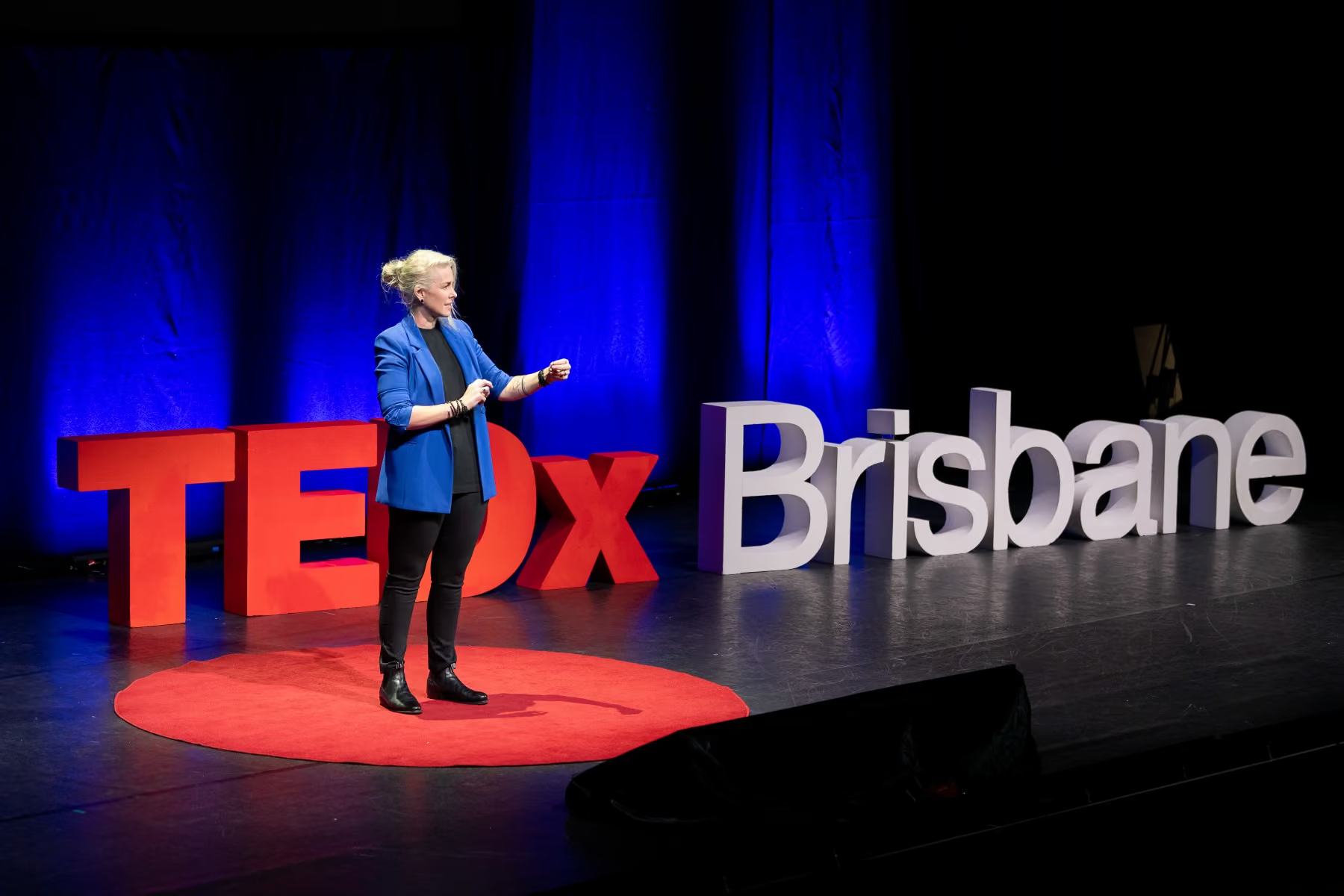
Read the transcript
If we want young people to go FAR we need them to be more than just resilient, we need them to be agile.
This is something I’ve learned after two decades in education, working with more than 130 000 students and their teachers, schools, and systems - designing learning experiences that engineer ‘productive friction’, deliberately placing young people inside moments of stretch and uncertainty.
Now, friction is the force that opposes motion.
Productive friction lives in the space between “I can” and “I can’t.”
Productive friction is the perfect playground for potential to be realised.
Because potential isn’t realised doing something easy.
And while the idea I want to share with you today is grounded in research, it didn’t start there.
It started in an all boy’s Year 9 English class. Yes.
My Head of Department told me that “volunteering” for this project would be “good experience”.
Which I’m sure was code for ‘nobody else wants the class.’
It was no coincidence that this class had an eclectic mix of the more interesting boys in the cohort.
It was thought, at the time, that by bringing these characters into a single English class, we (and by “we”, I mean “me”) could provide these boys with the targeted support they would need to re-engage back in their education.
What could possibly go wrong?
As a teacher, I only ever had two rules in the classroom. The first rule was “We stop learning when we stop listening.” In a world where notifications flash on our watches, phones and everything in between, sometimes the greatest gift we can give others is our attention.
The second was, “If you waste time, you pay it back.” And, as a chronic procrastinator, I live with the consequences of that rule almost every day.
Which is why, it was no surprise that when two of my students took a bathroom break that took them via the water bubbler on the other side of the school, they found themselves repaying that time on their lunch break.
With only moments left of our shared incarceration, one of the boys looked up at me and said.
“I don’t mean to be rude, miss, but…”
Now, we all know that nothing good happens at the end of that sentence.
So, on the outside, I put my best teacher face on. You know the one. Everything moves in slow mo. You lean forward, your eyes narrow, and then at the end, you just lift your eyes slightly; daring the student to finish their sentence.
On the inside, I cringed, “Please, don’t do it.”
“I don’t mean to be rude, miss, but… Why are we doing this?”
Now, here was a question I’d heard before. No seasoned teacher survives without developing an arsenal of responses to this one.
“It’s important to learn how to learn.”
“You don’t know when you’ll need this in your future.”
Or, my personal favourite, “This is a building block of knowledge that will unlock other, more fun, learning later.”
At the time, the boys, like all of Year 9, were being asked to read a novel and being asked to write an analytical essay on one of the themes from the novel. It was pretty stock standard English fare.
Ah, the reality – they were never going to read the book.
Most had a reading age of Year 4 or 5, far below the literacy level required.
And, some could barely spell “analytical essay”, let alone write one.
As I opened my mouth to auto-pilot a reply, I found myself instead saying, “Because we have to... and I’m sorry.”
...This random moment of radical honesty has stayed with me ever since.
Did we have to?
Because the truth of the answer is that a lot of what we ask young people to do at school is designed to help them succeed in school — not necessarily to succeed in life.
And if I had to sum up the problem in a line, it would be this:
School gets more predictable as students get older — right when life gets less predictable.
As students move through our education system, learning tends to narrows.
Tasks become more structured.
Outcomes become more defined.
And, success… Well that becomes about getting the “right” answer — in the “right” way.
This narrowing occurs precisely as young people’s cognitive capacity expands.
Their abstract reasoning increases.
Their executive functions strengthen.
Their cognitive flexibility… well, that improves.
What changes, though, is their experience of failure.
In adolescence, fear shifts.
It becomes less about physical risk — and more about social risk.
Failure stops being about falling over…
and starts being about being seen falling over.
Judged.
Embarrassed.
Labelled.
But, here’s the paradox.
Right at the developmental moment when young people need to practise navigating uncertainty most, we scaffold away the struggle; quietly teaching the opposite.
Which brings us to here:
We’re training young people to succeed in certainty… then judging them for struggling in uncertainty.
When we notice this gap, the usual response is to talk about resilience.
And resilience does matter.
But the way we’ve taught resilience often misses the practical application.
Resilience is often theoretical; explaining how to recover after a hypothetical fall.
But you can’t fully learn how to handle discomfort just by talking about it.
And often, resilience is taught in really heavy contexts.
Which is not exactly a safe place to practise.
So, we find ourselves here:
We’ve built an education system that minimises exposure to failure — and then we act surprised when students fear it.
Firstly, we need to be more precise about the capability we’re trying to develop.
Resilience is how you recover after the fall.
Agility is the action we can take whilst you’re still in motion.
Agility means:
persisting when things feel uncertain
adapting when things don’t work
And staying calm under pressure
In a world defined by uncertainty, unpredictability and friction - this distinction matters.
Agility is the capability this changing world demands.
And yet, many young people have never been taught how to do it.
The solution is surprisingly simple.
Build agility the way we build anything: With fast, frequent, and fun practice.
In classrooms, this looks like:
10 to 15-minute challenges
once a week
embedded into existing curriculum
And there’s a simple recipe to these engineered challenges.
The first ingredient is… Friction.
Not random difficulty — calibrated stretch.
Too little stretch, and there’s no growth. Too much, and the brain’s threat response takes over.
Psychologists would call this the Yerkes-Dodson curve — performance actually peaks with a moderate level of challenge.
Now, this peak lives inside productive friction. Our job is to find that productive friction zone- and slowly inch the peak forward through…
… Action.
Agility is not a theory. It’s an action.
The Challenge design must provide the conditions for students to persist, adapt, and experience pressure in real time.
This is consistent with what we know from performance psychology — capability develops with deliberate practice at the edge of current ability, not passive exposure.
The third ingredient: Reflection.
Because experience alone doesn’t create learning.
Metacognition — the ability to think about your thinking — is one of the strongest predictors of transfer.
After each challenge, students must have the space to ask:
What went well?
What didn’t?
What would I do differently next time?
Why does that matter?
Friction. Action. Reflection.
That’s FAR.
It’s not a theory. It’s developmental science applied deliberately.
Let’s look at FAR in action.
One example is something a challenge we like to call the "Festival of a Random Object."
Students are placed into random teams — often with people they don’t normally work with — and are given ten minutes to design an entire festival experience that heroes a completely unexpected object of the group’s choice. This could be the potato. Or, the bidet. That’s happened.
A second example of these challenges is something we like to call “Silent Sleuth”. Students walk into a silent classroom. On each desk, is a different unseen “Challenge”. On the board is a timer that has already started ticking down.
In one, there’s the chaos of collaboration. In another, there’s the stress of silence.
In both, we have no single right answer to the challenge and the pressure of time.
Some students enjoy this. Others find the conditions uncomfortable.
But, that's deliberate. We’re engineering productive friction. Afterwards, we don’t ask who won.
We ask: What did you do when you got uncomfortable?
Did you step back?
Did you step up?
Did you get frustrated?
Or did you decide the task was stupid… and tap out entirely?
Because it’s in these moments — not the outcome — are where agility is revealed… and built.
And, we know this works.
We’ve tracked changes across nearly 2,000 students in 40 schools.
When teachers embed agility across a ten-week term, students' confidence in their own agility grows by 10 percentage points. That’s one percentage point a week.
But maybe the piece that surprised us is that some of our most under-resourced schools — government schools, regional, remote — showed the most significant shift.
Despite cosmetic upgrades — smartboards, iPads, BookTok — the fundamentals of education, of teaching and its relationship to learning, haven’t shifted significantly.
In most classrooms, success is still measured by assessment tasks that privilege the learner who can regurgitate the facts back the fastest, and in the right order.
And here’s the thing we don’t always like to admit:
Sometimes we protect young people from friction… because friction makes us uncomfortable.
In this way, young person’s comfort zones begin to mirror the comfort zones of the adults closest to them.
It’s often easier to just teach the content.
Easier for us to control the outcome.
Easier for us to avoid the mess.
But what’s easier for adults is not always what’s best for young people.
Because when we remove the opportunity for productive friction, we don’t remove discomfort from our young people’s lives.
We just delay it.
What if, once a week, young people practiced navigating uncertainty and friction the way we practise literacy and numeracy.
They wouldn’t be resilient eventually.
They’d be agile now.
And that’s what the world they’re entering actually demands.
Because the safest place for a young person to fail isn’t out there.
It’s in here.
With a teacher who’s brave enough to step back —
and let their students step up.
Know a teacher (or parent) who needs to see this? Share it.
Here's how to bring FAR into your classroom.
The solution is surprisingly simple. Build agility the way we build anything: with fast, frequent, and fun practice. How? 10-to-15-minute challenges, once a week, embedded into existing lessons.
Here are two ways to start.

The Classroom Agility Starter
A free, downloadable kit to bring agility into your classroom this week.
- A 2-minute quiz to reveal your personal Agility Profile
- A sample of ready-to-run Agility Builders
- Classroom posters + a student reflection template
The Staffroom Agility Starter
A free, ready-to-run staff meeting kit that turns the 12 minute TEDx talk into whole-school conversation.
- Three formats — 20, 30 or 45 minutes — resourced and scripted.
- A design challenge that lets staff feel productive friction, not just discuss it.
- A printable Reflection Sheet with a self-scored Agility Check-In.