
Agency is the Antithesis of Compliance

Founder and CEO of Future Anything, Nicole Dyson is a multi-award-winning educator and entrepreneur, and a global authority on project-based learning, entrepreneurial pedagogy and school transformation. A former school leader in Australia's public system, she also founded YouthX (Australia's only startup accelerator for school-aged entrepreneurs) and Catapult Cards (design thinking toolkit that donates 50% of profits as micro-grants to youth-led startups).
Over the past couple of years, the surge in the conversation around the importance of student ‘agency’ has hit a fever pitch.
We know developing young people with agency is critical – but the real question, for me, is how we do this.
Agency is not a mythical creature that is manifested by repeating the word three times into a mirror – or the classroom.
And, given the structures and systems that are present in most schools that actively disable any sense of agency in and for young people, it’s easy to see why the buzz around ‘building agency’ and the reality of young people having agency has been somewhat lost in translation.
I mean, if students don’t have enough agency to choose when they go to the bathroom or when they eat – how do they develop the confidence to lead their own learning… or life?
Building enterprising thinkers
When I stepped out of the classroom to start Future Anything, it was on a hunch that entrepreneurship could be a vehicle for young people to use their curriculum as a problem catalyst to be solved – rather than be judged on how well they can regurgitate facts back in the right order.
Over the past five years, that work has evolved for us. We no longer see ourselves as an entrepreneurship education organisation. Our mission is to build enterprising students, educators, schools and systems.
But what do we mean by ’enterprising’? We love the Merriam Webster definition:
enterprising adjective. en·ter·pris·ing | \ ˈen-tər-ˌprī-ziŋ , ˈen-tə-ˌprī- \
: marked by an independent energetic spirit and by readiness to act
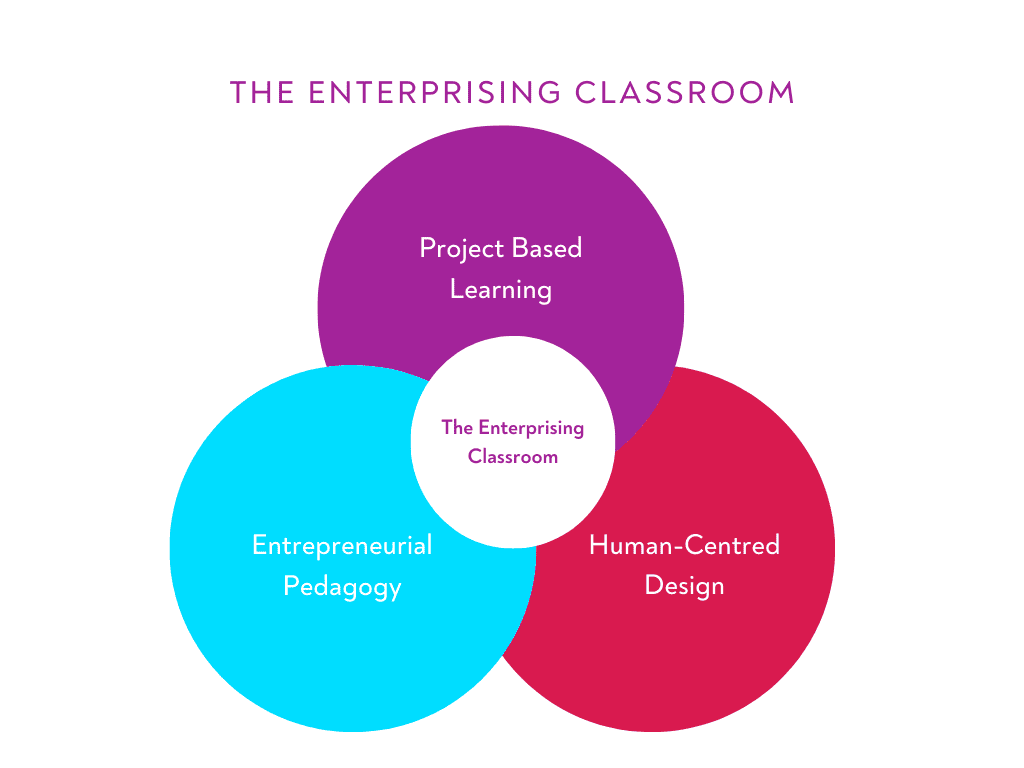
We believe the ‘enterprising classroom’ sits at the convergence of three pedagogical approaches:
- project-based learning,
- human-centred design thinking, and
- entrepreneurial pedagogy.
We draw from the work done by PBLWorks and their Gold Standard Framework for Project-Based Learning, with a particular focus taken from this work to build learning that is student-centred and real world.
We also take inspiration from the work of IDEO, and focus on building learning that privileges divergent thinking and an iterative approach to assessment that uses feedback as fuel to get better.
In building student agency, entrepreneurship is the means, not the end.
And finally, unlike entrepreneurship education, where the entrepreneurial product at the end is the primary purpose of the learning, the end point of entrepreneurial pedagogy is to entrepreneurship as a vehicle that enables young people to learn how to ‘think’ like an entrepreneur.
To ‘think’ like an entrepreneur, we focus on building (and then measuring), our educator’s proficiency and our young people’s confidence in six critical capabilities:
- Critical Thinking
- Creativity and Innovation
- Problem Solving
- Adaptive Mindset
- Communication
- Project Management
Over the past three years, here at Future Anything, we’ve been benchmarking young people and educators in their confidence in these capabilities through our award-winning, in-curriculum The Future Anything Challenge (formerly Activate).
Prior to delivering The Future Anything Challenge, educators are asked how confident they feel teaching these capabilities, and students are asked how well they understand what the capability is, and how confident they feel in their own abilities in each of them.
Data is synthesised to provide each of The Future Anything Challenge schools with personalised insights of their own young peoples through a bespoke benchmark report, with aggregated national data used to inform the ongoing design and evolution of The Future Anything Challenge curriculum.
Creative confidence is everything.
We have gained powerful insights from this research.
Firstly, it won’t come as too much of a surprise to note that the benchmarking confidence of the educators almost always mirrors the benchmarking confidence of the young people.
The reality is that we can’t teach something that we don’t feel confident in ourselves.
Secondly, ‘creativity and innovation’ is most often the capability of lowest confidence for both cohorts.
Our relationship to creativity is often birthed in our experience with the creative arts. If we find ourselves struggling with painting, drawing or making music, we adopt the narrative that we’re not a creative person.
In The Creative Act: A Way of Being, Rick Rubin says “The ability to look deeply is the root of creativity.”
In this way, creativity is often a way of thinking – not just doing.
This dip in creative confidence is interesting when you consider another hunch I have.
Creativity is the linchpin skill for all the others.
Can you be a great communicator, project manager, problem solver, or critical thinker without having the creative confidence to sit with possibility?
Can you see feedback as fuel, and have an agile and adaptive mindset without catalyzing creativity to find new ways of working, or thinking?
Thirdly, over the past three years, we’ve seen incredible growth in these capabilities through The Future Anything Challenge.
But, with this comes the perhaps startling realisation that it’s just not possible to explicitly teach six capabilities within one ten-week unit of curriculum. Yes, students (and teachers) will interact with all the capabilities through our enterprising curriculum – but to teach all of these skills in an explicit way? It’s just not possible.
The greatest impact we have seen is where teachers use their classes’ The Future Anything Challenge benchmark data to target a focus capability for the unit. This might be the capability that showed up as the weakest, or it might be the capability that aligns with
Then, in the classroom, we follow this framework:
- We define the capability for students, and we provide and describe examples and non-examples. It’s just as important to show young people what the capability looks like when it goes horribly wrong, as well as when it goes magically right. This enables young people to see the capability as a continuum.
- Next, we benchmark the young people in the target capability. Each capability has a set of ‘skills’ that sit underneath it, and students self-assess which skills are strengths, and which are opportunities. It’s critical that young people own their data in this step – they need to understand where they ae on the continuum and what they may need to do to move further along in the capability.
- Then, we practice. Capabilities are developed with fast, frequent, and fun practice. Importantly, students must experience success in the first instance. Without this, they will fail to build the motivation to engage in more complex asks. The reality is, as adults, we don’t continue to do things that we suck at. If you want to build agency, you need engagement. To get engagement, you need motivation. To get motivation – young people need to experience success. Our research indicates that if you can build one ten-minute ‘practice’ activity in the capability once a week for ten weeks, you will see significant growth.
- After sufficient practice (at increasing levels of complexity – consider the zone of proximal development research) students then perform the capability under the assessment conditions. We measure what we value, and we value what we measure. It’s critical that young people see that the practice they were afforded has set them up for success- this builds trust, which then creates engagement in the learning process.
- Finally, we reflect. This is the step that often falls off the lesson plan in the busy of Week 10. We intend to reflect, but we fail to prioritise the time to do this meaningfully. You cannot have transferral of learning without meaningful time to reflect on what went well, what didn’t, what could be done differently next time, and why that matters.
Agency is the product of student confidence in these capabilities.
Finally, perhaps the greatest insight I’ve come to through this work is that agency is not a mythical creature that is manifested by simply talking about agency.
I believe agency is the product of these six capabilities; creativity and innovation, problem-solving, adaptive mindset, communication, critical thinking, and project management.
It is when young people can wield all six of these capabilities with confidence that they then have agency in their learning – and, more importantly, in life.
And, in this way, agency is the antithesis of compliance.
A compliant classroom is easy; students do what they’re told when they’re told to do it.
But those same young people flounder in the real world where life more.
They then become the colleagues in our workplaces that frustrate us. These colleagues don’t do anything unless they’re told to do it. They lack problem-solving skills and the creativity to find new ways of working. They aren’t adaptive and they can’t manage a project.
In short, they lack agency.
Conversely, colleagues with agency recognise obstacles or challenges in front of them, and instead of waiting to be told what to do, they do something about them.
They step up.
And, at the end of the day, isn’t that what we’re all working towards?
A generation of enterprising thinkers and doers.
Check out The Future Anything Challenge.