
Agility is the New Resilience
.jpg)

Founder and CEO of Future Anything, Nicole Dyson is a multi-award-winning educator and entrepreneur, and a global authority on project-based learning, entrepreneurial pedagogy and school transformation. A former school leader in Australia's public system, she also founded YouthX (Australia's only startup accelerator for school-aged entrepreneurs) and Catapult Cards (design thinking toolkit that donates 50% of profits as micro-grants to youth-led startups).
As the world of work is redrawn around them, our young people need more than the ability to bounce back. Nicole Dyson explores why Agility is the future-ready capability that matters most, and shares the FAR method — plus 10 fast, and fun ways to build it in your classroom.
The world our young people are walking into is not the world we were trained for.
By 2030, the World Economic Forum estimates that 39% of the core skills workers need will have changed. Automation and artificial intelligence are forecast to displace 92 million roles and create 170 million new ones, a churn equivalent to 22% of all jobs within five years (World Economic Forum, 2025).
The capabilities employers value are shifting accordingly. In the WEF's 2025 Future of Jobs Report, the highest-ranked core skill was analytical thinking, followed immediately by resilience, flexibility and agility, a cluster that recorded one of the steepest rises of any skill, up 17 percentage points in just two years.
For much of the past decade, education's answer to a changing world has rested on a single word: resilience. And resilience matters. But on its own, it's not enough.
Resilience is how we recover after the fall.
Agility is the action we take while we're still in motion.
Agility is the new resilience.
It's the capability that allows young people to persist when things feel uncertain, adapt when an approach doesn't work, and stay calm under pressure — not in hindsight, but in real time. In a world defined by uncertainty, unpredictability and friction, that distinction matters.
And yet a paradox persists in our classrooms:
School gets more predictable as students get older — right when life gets less predictable.
As students move through the system, learning narrows. Tasks become more structured. Outcomes become more defined. Success becomes about getting the "right" answer, in the "right" way.
This narrowing happens at exactly the developmental moment when young people most need to practise navigating uncertainty.
We scaffold away the struggle. Then we act surprised when students fear it.
That gap — between the certainty we train for and the uncertainty the world demands — is where Agility lives.
I spoke about The Power of Productive Friction at TedxBrisbane in 2026. If we want young people to go FAR, we need them to be more than just resilient, we need them to be agile.
Enter the Future Anything Capability Framework
The Future Anything Capability Framework identifies six future-ready capabilities that sit at the heart of our programs and learning design: Curiosity, Creative Thinking, Critical Thinking, Communication, Action, and Agility.
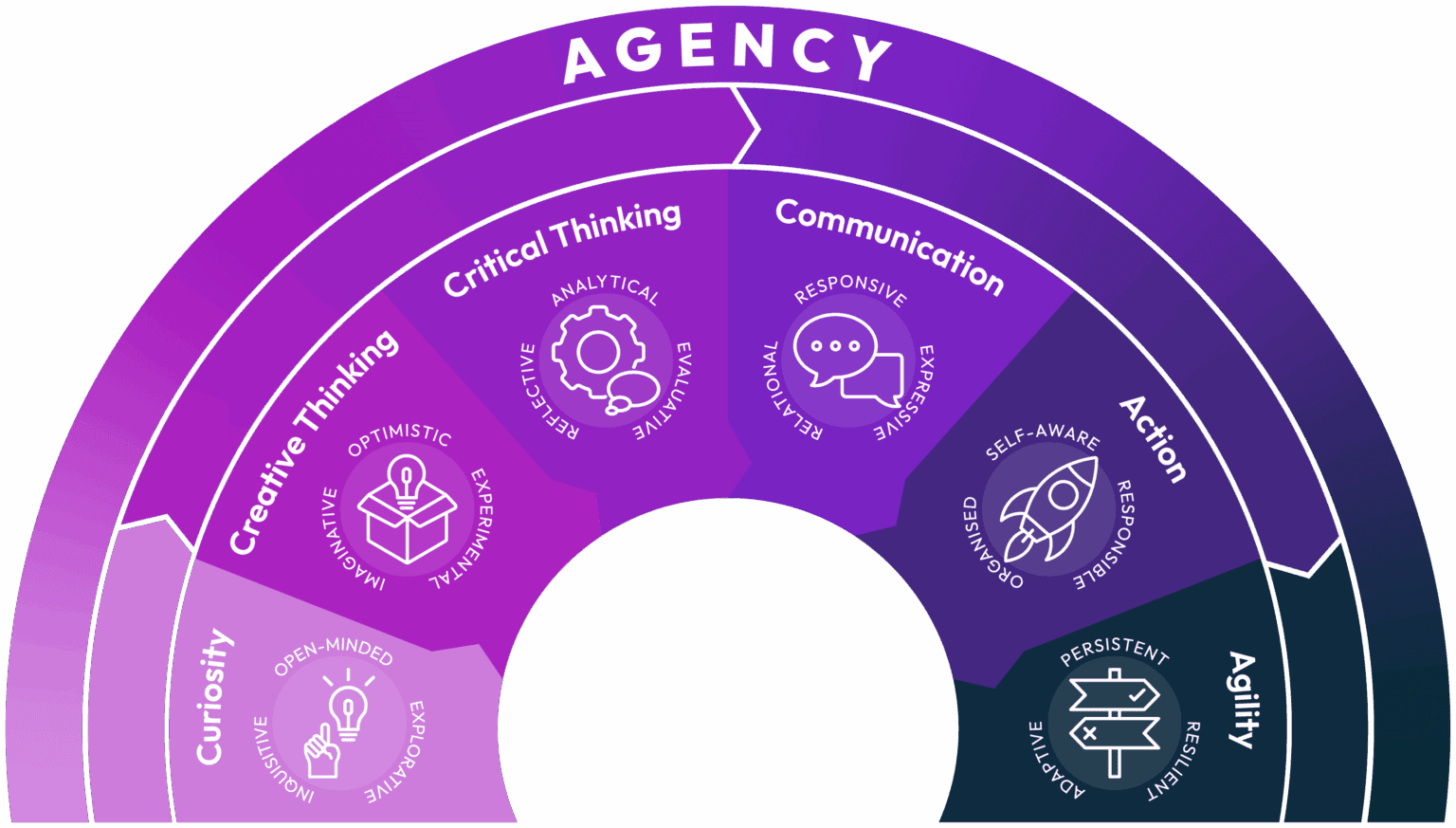
Rather than treating these as a "bolt-on" to curriculum objectives, we position them as the foundational skills that empower young people to bend the future — rather than just inherit it. They're about the how, not just the what.
If Curiosity is the spark that starts it all, Agility is the capability that keeps students moving when the path gets uncertain.
And in a world defined by change, that matters more than ever.
What is Agility?
In our Capability Framework, we define Agility as:
"The ability to adapt, persist, and stay resourceful in the face of change or challenges."
It's made up of three core competencies (sub-skills):
• Resilient: Staying calm under pressure and learning from mistakes.
• Persistent: Continuing to take action — even when things feel difficult or uncertain.
• Adaptive: Changing strategies and applying feedback to improve.
This distinction has direct implications for how we teach. For years, our efforts to build resilience have been largely theoretical — explaining to students how to recover after a hypothetical has gone wrong. But discomfort is difficult to learn about in the abstract.
Agility is different, because it can be practised. It asks students to persist when things feel uncertain, adapt when an approach doesn't work, and stay calm under pressure — in real time, at low stakes, and often enough that the capability becomes a habit.
Why Agility Matters: What the Research Says
Our work on Agility is anchored in Robert Sternberg's concept of adaptive intelligence — "the intelligence one needs to adapt to current problems and to anticipate future problems of real-world environments" (Sternberg, 2021).
Sternberg draws a sharp line between the problems school rewards and the problems life actually serves up.
Test problems are tidy: well-structured, low-stakes, low-arousal, with a single right answer reached in minutes. Real-world problems are the opposite — messy, high-stakes, emotionally charged, and they unfold over time with no clear path and no guaranteed solution.
The skills that help a student ace the first kind don't reliably transfer to the second.
Agility is how we close that gap. And the research that underpins our framework says the same thing from every angle:
• The world is demanding it. It's not just employers (World Economic Forum, 2025). The OECD Learning Compass 2030 positions student agency and the capacity to navigate uncertainty as core to thriving in an unpredictable future — not optional extras, but transformative competencies.
• It's teachable. Adaptation isn't a fixed trait you're born with or without. It's a skill that can be deliberately modelled, scaffolded, and practised (Sternberg, 2021).
• Feedback fuels it. Feedback is "among the most powerful influences on learning and achievement" (Hattie & Timperley, 2007) — the engine of the Adaptive sub-skill, where students seek out input and adjust their approach.
• Iteration builds it. Give students the chance to try, fail, and refine, and they develop a measurable sense of control and stronger performance — with metacognition doing much of the heavy lifting (Looijenga, Klapwijk & de Vries, 2015).
• Failure needs a safe home. Reframing failure as "failing forward" only works when the classroom is psychologically safe enough to fail in (Ellerton, 2019).
We know the future of work for our young people is uncertain. We know the world they're walking into is one of constant change.
So if we want them to thrive in it, we have to stop protecting them from struggle — and start building their agility.
The "How": Fast, Fun, Frequent — and the FAR Method
Agility is built the way any capability is built: through fast, fun, frequent practice.
In our work at Future Anything, that takes the form of 10–15 minute challenges, roughly once a week, embedded within lessons teachers are already delivering. Our research shows growth of 5–8% in target capabilities for secondary students, doubling to 10–16% in primary students, from spending just 10 minutes a week over ten weeks.
The curriculum is already crowded. The intention is not to add to it, but to re-orientate the ten-minute Hook, Brain Break or Exit Ticket teachers already use so that it carries a capability focus.
Every effective agility challenge shares a simple anatomy, which we call FAR:
.png)
Friction. Not random difficulty — calibrated stretch. Too little and there's no growth. Too much and the brain's threat response takes over. Psychologists call this the Yerkes-Dodson curve: performance peaks at a moderate level of challenge. Our job is to find that productive friction — the space between "I can" and "I can't" — and gently inch it forward.
Action. Agility is not a theory. It's an action. The challenge has to create the conditions for students to persist, adapt, and feel pressure in real time. This is exactly what performance psychology tells us: capability develops through deliberate practice at the edge of current ability, not passive exposure.
Reflection. Because experience alone doesn't create learning. Metacognition — thinking about your thinking — is one of the strongest predictors of transfer (Schön, 1983; Hattie & Timperley, 2007). Afterwards, students ask: What worked? What didn't? What would I do differently next time? Why does it matter?
Friction, action, reflection: together, they are what turn a fun classroom moment into a capability students carry with them.
10 Practical Activities to Build Agility in the Classroom
The following ten activities each build one or more of the agility sub-skills, and each follows the FAR anatomy — engineer a little friction, move students into action, then reflect. They rise in complexity, work across primary and secondary contexts, and require minimal preparation. They are designed to be used one at a time, as a single short challenge each week.
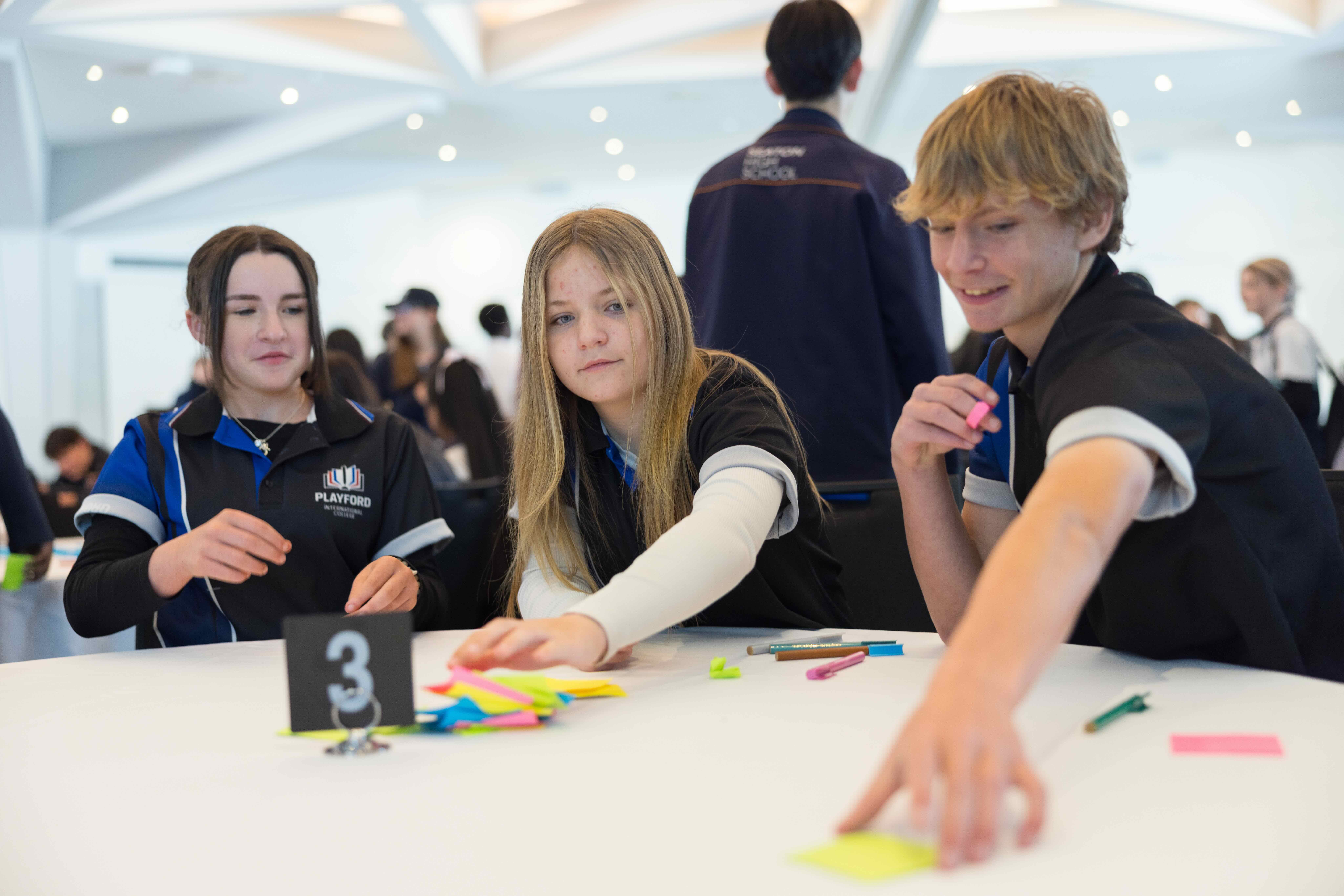
1. The Rule Change Challenge
Sub-skill: Adaptive & Persistent · Year Levels: Upper Primary – Secondary
Students play a familiar game — tic-tac-toe, rock-paper-scissors, a quick card game. Every 30 seconds, announce a new rule ("X can't go in the middle," "rock now beats paper"). Players must adjust immediately and keep playing.
Reflect: How did you react to the new rules? What strategies helped you adjust? Where do the rules change unexpectedly in real life?
2. Back and Forth Story
Sub-skill: Persistent & Adaptive · Year Levels: Primary – Secondary
In silent pairs, students co-write a story — one or two sentences each turn — with every contribution adding a twist that changes direction. No talking allowed.
Reflect: Were you able to go with the flow and build on your partner's changes? When have you had to adapt to someone else's direction in real life?
3. My Favourite Mistake
Sub-skill: Resilient · Year Levels: Primary – Secondary
Each student recalls a mistake or failure they now feel positive about, and writes a short reflection: what it was, how they felt, what they learned, and how it shaped what they did next. Share in a safe, supportive space.
Reflect: Why is this mistake now valuable to you? How can learning from mistakes change the way you approach the next setback?
4. Pivot Challenge
Sub-skill: Adaptive & Persistent · Year Levels: Upper Primary – Secondary
Small groups begin a short challenge — a puzzle, a LEGO build, a quick sketch. Every three to four minutes, call "Pivot!" and groups rotate to continue another team's unfinished work, sometimes with a new instruction.
Reflect: How did it feel to pick up someone else's work? What helped you adjust quickly? Where might you need to do this in real life?
5. Brainwriting Feedback
Sub-skill: Adaptive · Year Levels: Upper Primary – Secondary
Students write an idea in a sentence or two, then pass it around a table of four. Each person silently adds "I like… / I wonder…" feedback before passing it on. When the page returns, students improve their idea using the most useful input.
Reflect: Which feedback was most helpful, and why? How does it feel to treat feedback as fuel rather than criticism?
6. Fail Forward Experiment
Sub-skill: Resilient · Year Levels: Primary – Secondary
Students think of a time they failed at something — personally or in a project — write down the experience, and reflect on what they learned. Connect it to how entrepreneurs fail, learn, and pivot.
Reflect: What did your failure teach you? How does "failing forward" help you grow?
7. Case Study: Netflix vs Blockbuster
Sub-skill: Adaptive · Year Levels: Secondary
Pose the scenario: it's the year 2000, you run a successful DVD-by-mail business, and Blockbuster has just refused to buy you out. In eight minutes, teams design how they'd adapt the business — then compare their thinking against what Netflix actually did.
Reflect: What's the difference between adapting and giving up? Where could you use this kind of thinking in your own project?
8. Blindfolded Instructions (LEGO)
Sub-skill: Persistent & Resilient · Year Levels: Primary – Secondary
One partner is the blindfolded builder; the other instructs — without naming specific pieces. Halfway through, add a twist: "now describe using shapes only, not colours." Then swap roles.
Reflect: What was most challenging? How did you adjust to the change? How did your partner's feedback help?
9. ProtoBot Challenge
Sub-skill: Resilient (calm under pressure) · Year Levels: Upper Primary – Secondary
Teams use protobot.org to generate a random product or service idea, then have ten high-pressure minutes to map it out, sketch it, and storyboard someone using it before submitting to the front of the room.
Reflect: How did you manage the pressure as a team? What did you learn about how you work when the clock is running?
10. Before vs After
Sub-skill: All three · Year Levels: Primary – Secondary
A closing reflection. Students revisit the agility definition and sub-skills, then represent their "before" and "after" — the challenges they met this term and how they responded — as an image, a journey map, or even a rap.
Reflect: Where have you grown in a short time? What's the next challenge you'll bring your agility to?
Want to Dig Deeper? Recommended Resources
A curated mix of voices and tools to take agility further:
Books
• Adaptive Intelligence: Surviving and Thriving in Times of Uncertainty — Robert J. Sternberg
• Black Box Thinking — Matthew Syed, on the habit of learning from failure rather than fearing it
• Mindset: The New Psychology of Success — Carol Dweck
Tools & challenges for the classroom
• ProtoBot — a random product/service generator for fast, high-pressure design sprints (with a "clean" mode for younger students)
• James Dyson Foundation Challenge Cards — 44 free, hands-on engineering challenges designed by Dyson engineers
• Destination Imagination Instant Challenges — quick, think-on-your-feet team challenges, intentionally designed to have many possible solutions
• Breakout EDU — escape-room-style problem solving that builds persistence and adaptability under time pressure
• PBS Design Squad Global — free build-it engineering challenges using everyday materials
• The Marshmallow Challenge (Tom Wujec) — a classic timed, iterative build that reveals how teams adapt under pressure
Final Thoughts
There is a harder truth beneath all of this. At times we protect young people from friction because friction makes us uncomfortable. It's easier to teach the content, to control the outcome, to avoid the mess. But what's easier for the adults isn't always what's best for the young people, and removing every opportunity for productive friction does not remove discomfort from their lives. It simply delays it.
If every student practised uncertainty once a week the way they practise literacy, they wouldn't merely become resilient in time. They would be agile now — which is precisely what the world they're entering demands.
Because the safest place for a young person to fail isn't out there. It's in here. In a classroom. With a teacher brave enough to step back, and let them step up.
Let's build capability-rich classrooms. And if we do, our young people won't just be ready for the future.
They'll bend it.
References
Ellerton, P. (2019). On critical thinking and collaborative inquiry. Adolescent Success, 19(1).
Hattie, J., & Timperley, H. (2007). The power of feedback. Review of Educational Research, 77(1), 81–112. https://doi.org/10.3102/003465430298487
Looijenga, A., Klapwijk, R., & de Vries, M. J. (2015). The effect of iteration on the design performance of primary school children. International Journal of Technology and Design Education, 25(1), 1–23. https://doi.org/10.1007/s10798-014-9271-2
OECD. (2019). OECD Learning Compass 2030: A series of concept notes. Organisation for Economic Co-operation and Development.
Schön, D. A. (1983). The reflective practitioner: How professionals think in action. Basic Books.
Seel, N. M. (Ed.). (2012). Adaptability and learning. In Encyclopedia of the Sciences of Learning. Springer.
Sternberg, R. J. (2021). Adaptive intelligence: Its nature and implications for education. Education Sciences, 11(12), 823. https://doi.org/10.3390/educsci11120823
World Economic Forum. (2025). The future of jobs report 2025. World Economic Forum. https://www.weforum.org/publications/the-future-of-jobs-report-2025/
Check out our Student Innovation Workshops.