
What We Can Learn From the 2026 National Grand Final Applications

Founder and CEO of Future Anything, Nicole Dyson is a multi-award-winning educator and entrepreneur, and a global authority on project-based learning, entrepreneurial pedagogy and school transformation. A former school leader in Australia's public system, she also founded YouthX (Australia's only startup accelerator for school-aged entrepreneurs) and Catapult Cards (design thinking toolkit that donates 50% of profits as micro-grants to youth-led startups).
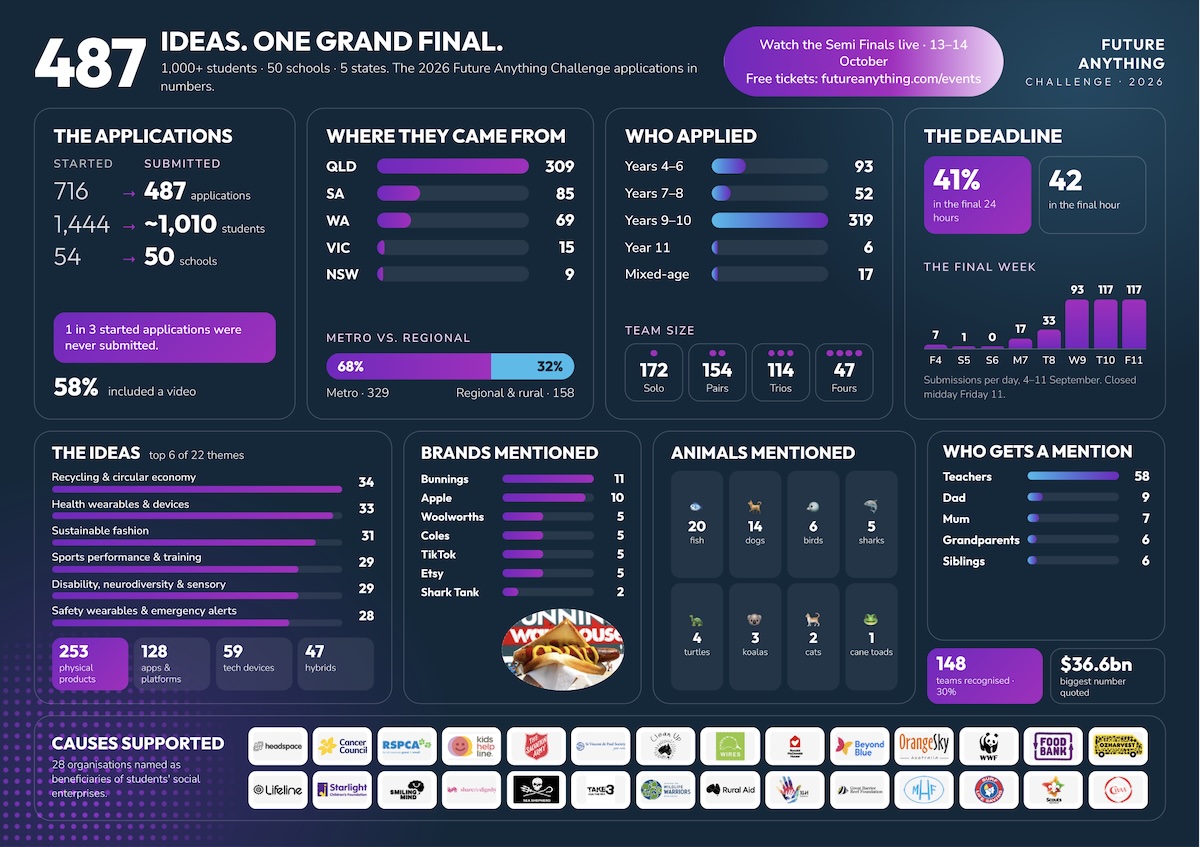
2026 was the biggest year for submissions for the Future Anything Challenge Finals ever!
We had more than 700 applications started, and 487 applications submitted before the deadline, from 1,000 students across more than 50 schools and five states.
Whether you made it to the next stage or not, we'd like to congratulate all teams who created such compelling, exciting ideas, and acknowledge the wonderful teachers who supported them.
The reviewers had a super hard task narrowing the field to the top 48 pitching teams. These teams will now head to the Future Anything Challenge Semi Finals held live and online on the 13th and 14th October. A further 17 showcase teams will progress directly to the Future Anything Grand Final Showcase being held on Monday November 9th at our new home, The Thomas Dixon Centre in West End, Brisbane.
A further 85 submissions have also been recognised as Highly Commended by the reviewers.
Despite expanding the field of recognition to the 150 teams this year, there were plenty of strong teams with great ideas that missed out.
If this is you, we know the news will be disappointing. The reviewers want you to know that your passion, and the potential of your idea still matters, and that many of our most successful entrepreneurs used disappointment as fuel for their future success, learning from these experiences. In fact, Melanie Perkins pitched Canva to more than 100 investors before one said yes. James Dyson built 5,126 prototypes that didn't work before the one that did. And. Walt Disney was fired from a newspaper for having no good ideas.
Plenty of great ideas don't get their shot the first time. What really counts is what you do with your idea tomorrow.
That's what this page is for. Scroll down to check out the patterns from all 487 applications - the clusters of ideas, what we noticed, alongside what the reviewers would have loved to have seen instead: tangible and actionable feedback that current teams (and future Future Anything Challenge teams) can apply.
And, if you're a teacher of entrepreneurship education in classrooms, we then convert these trends into six practical ways you can level up your enterprise classrooms tomorrow.
What matters to young people in 2026?
With more than 1,000 students on close to 500 teams, aged 9 to 17, this year's ideas are a snapshot of what really matters to this generation. The thinking ran the full spread: 253 physical products, 128 apps and platforms, 59 tech devices, from hand-sewn prototypes to working AI. And the wicked problems they chose tell their own story: a planet drowning in waste, mental health support that isn't reaching their generation, inclusion for people with disability and neurodiversity, and keeping the people they love safe, whether it was women walking home, grandparents ageing at home, kids online.
Crowded categories raised the bar, though. Similar ideas faced increased pressure to support their point of difference, separating themselves from existing, Googleable solutions as well as from other submitted ideas.
And for the first time, reviewers saw AI as the architect of ideas. On a number of occasions, the same idea was submitted by different teams from different schools, with the same business name!
If an AI tool can hand your idea to another team, it isn't your idea.
Use AI to stretch your thinking, not to do it for you.
Strategies for Students: Levelling up ideas and applications.
As reviewers read responses, watched videos and studied prototypes, the same patterns started to emerge.
Last year, the reviewers asked teams to share the personal story behind their idea, and to explain their solution so clearly that anyone could understand it.
This year's field delivered on both: far more teams named the lived connection driving their idea, and nearly every application could be understood by a stranger in one read.
Competitor analysis was much stronger this year, too (two in three teams named real competitors!), and most teams proposed an ongoing business model rather than a one-off fundraiser.
But, the strongest applications had the triple threat:
- A personal connection to the problem. They named a person they knew that had a lived experience of the challenge they cared about.
- A nuanced or niche view of the problem. Rather than solve the whole problem, these teams isolated a root cause to solve.
- Genuine points of difference that moved beyond sustainability and affordability. They explained specific features or benefits to their idea that separated them from existing solutions.
Turning Student Ideas into Action
The strongest teams had also managed to turn their idea into action.
Here are ten micro-moves that generate traction (real-world proof that people want your idea), ordered easiest first.
1. Interview someone who lives the problem.
Find one person who deals with your problem every day through family, school or community. Ask what it's like, what they've tried, and what didn't work. Write down their exact words: their sentences are evidence your application can quote.
2. Survey your real target group.
Get twenty-five responses from the people your idea serves... not just your class! Ask what they struggle with, what they use now, and what they'd pay. Then report the numbers: "18 of 25 said..."
3. Turn your hand drawings into AI mock-ups.
Photograph your sketch and ask an AI tool to render it as the finished product or the app screens. Present it honestly: "this is a visualisation of our design", next to the real version you tested.
4. Reach out to your charity partner.
Planning to support a charity? Contact them and ask for a real partnership: tell them your idea, ask how donations would help most, and ask for a letter of support. A named partnership beats a promised donation.
5. Pitch your Principal.
If your idea fits a school, your first customer might be one corridor away. Ask for a term pilot: a short meeting, a one-page plan, a start date.
6. Ask an expert for feedback.
Research who the experts are in your chosen problem. For example, a nurse for a health idea, an engineer for a device, a vet for a pet product. Email them to set up a time to chat. Pitch your understanding of the problem and your idea, then ask open-ended questions that invite genuine feedback: "What would stop this from working?"
7. Build the smallest working version.
Cardboard counts. Paper screens of your app count. The point isn't polish, it's making the idea real enough that someone can try it. We want their feedback to be about the thing, not a description of the thing.
8. Get a real unit cost.
Email a manufacturer or supplier and ask what one unit would cost to make and manufacturing timelines. Turn this into a clear roadmap for taking your idea into the real world.
9. Sell at lunchtime at school.
Get permission, set a price, count what happens. Every sale is proof, and every "no thanks" is a question worth asking. Keep the tally: "we sold 14 units at $5 in 40 minutes" is a sentence reviewers remember.
10. Ask a business for a letter of intent!
The boldest move on the list. Ask a local business whether they'd buy: "would you order X at $Y when it's ready?", and get the answer in writing. A letter of intent is the strongest single piece of traction a young team can show.

Strategies for Teachers: Levelling up Entrepreneurship in the Classroom.
Great ideas come from great thinking. The trends above aren't really about applications, they're about how students approach problems and solutions, and that can be taught.
In entrepreneurship education, the purpose of the learning is to build a commercial product: the business is the outcome. In entrepreneurial pedagogy, the purpose of the learning is for students to think like an entrepreneur: the thinking is the outcome. It's the move from the noun to the verb: using real problems as the vehicle for learning, and linking the classroom to life outside the school gates.
Because the world doesn't need us to build a generation of entrepreneurs. The future demands enterprising young people, marked by an ‘independent, energetic spirit and a readiness to act’. Not every student will start a business, but every student can learn to think like an entrepreneur: to see a problem in front of them and have the agency and confidence to do something about it.
Taking the trends above, here are five easy wins for the classroom that stretch the way students approach problems and solutions, each with a resource you can use tomorrow.
1. Know your student’s Starting Line.
Every step of the enterprise journey leans on a different capability: problem exploration runs on curiosity, ideation runs on creativity, competitor analysis on critical thinking, pitching on communication, traction on action, and using feedback as fuel to iterate ideasruns on agility.
The Starting Line is Australia's first national snapshot of student capability confidence. It's a free, anonymous "I can..." survey with nothing scored, ranked or turned into a league table. Participating schools receive a capability profile of every cohort they register: a bird's-eye view of which capabilities your students are strong in, and which they're still building.
Map that profile against your unit and you can see the future. Are your students low in curiosity? They might struggle to connect with a problem they care about. Low in creativity? They may settle for their first idea. Low in agility? They might struggle to pivot when the feedback isn't what they hoped for. Perceived challenge shapes engagement; engagement shapes success, so before your students pick a problem, you'll know which parts of the journey they'll find hard, and can teach to it.
Use: The Starting Line: free, Years 5–12, runs in Term 4
Read: The Starting Line: why capability confidence is the invisible gap
2. Right-size the mission.
Every problem a student could choose sits somewhere on a ladder of context.
Me: a problem they've lived themselves.
Mine: a problem someone close to them lives.
Ours: a problem in a community they belong to.
Theirs: a problem in a community they've never been part of.
The further from home the problem sits, the harder it is for a young person to design something authentic.
This year's applications proved it. The strongest ideas came from the bottom rungs of the ladder: a family member's diagnosis, a job at the local shop, a sibling who struggled. The weakest showed the rise of the Heropreneur: young people positioned to solve problems on behalf of others, in communities they've never been part of. Before your students pick a world problem, walk them down the ladder and help them start where the lived experience is.
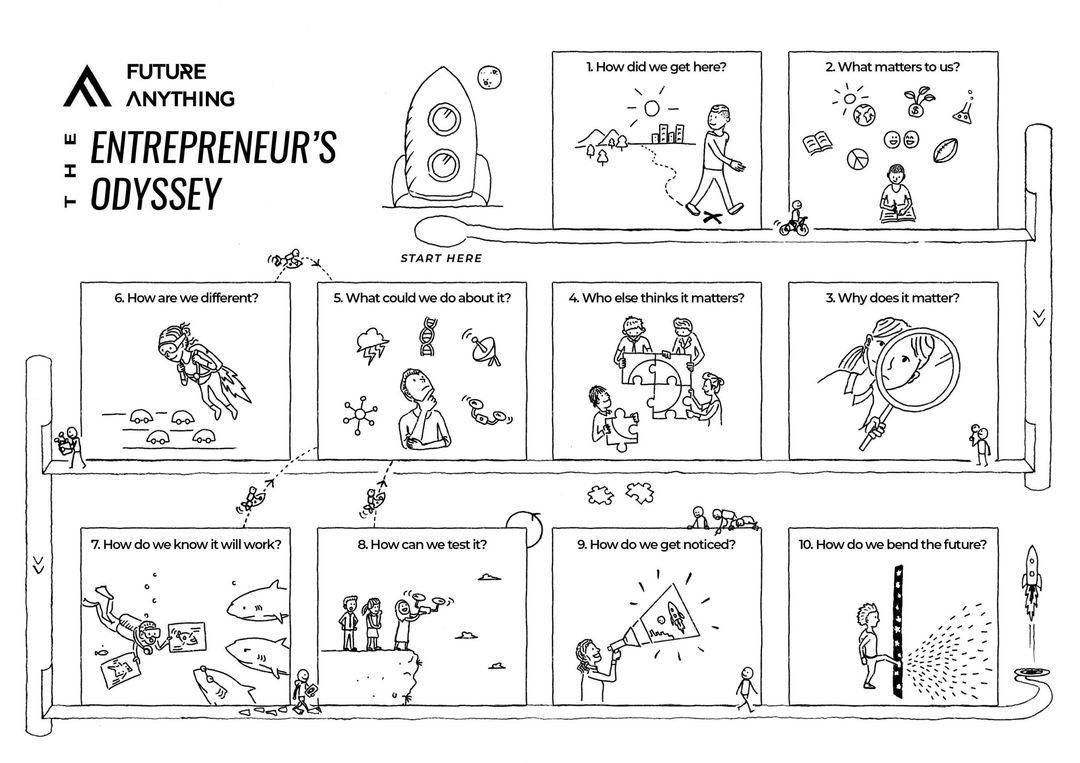
Read: The Entrepreneur's Odyssey: going bigger is not always better
3. Dig down to a root cause.
Once students have chosen a problem close to home, don't let them design for it yet, dig under it. The Root Cause Tree maps the five biggest causes of the problem, then keeps asking "and why does that happen?" until students pick the root cause they think matters most. A niche, specific problem produces a niche, specific idea. This is where "we're solving bullying" becomes "we're solving bullying at lunchtime, when students have spare time and teachers are stretched."
Use: The Root Cause Tree: a 30–45minute classroom activity, Years 4–12
4. Design the brainstorm, don't just hold one.
Great brainstorms don't happen by accident, they're the product of culture and conditions. Set the Rules of Play (Go Big,Go Wild, Go Together), then stack ideation strategies back-to-back until teams get as close to 100 ideas as possible, and prototype three: two they love, one wild one. If a chosen idea still sounds like everyone else's, the X-Factor deck in Catapult Cards pushes it from the mundane to the radical. The full playbook - the conditions, the strategies, and why 100 matters is in the resources below.
Read: A Playbook for Building Classroom Creativity
Read: Bust Out of Brainstorming: ideation for creativity
Use: Catapult Cards: start with the X-Factor deck inside the Kit
5. Run the Google Test, then let AI stress-test it.
The reviewers Google every idea, so teach students to get there first. This step is where the strongest applications separated: two in three teams named competitors this year, but far fewer used what they found to sharpen their own idea.
It's also where AI belongs in an enterprise classroom. Used at the start of the journey, AI is an architect, and this year it handed different teams the same idea with the same business name. Used at this step, it's a stress-tester: it can't make an idea yours, but it can tell your students fast who else already had it, and push them to defend what's different. Same tool, opposite ends of the journey. One flattens original thinking and the other sharpens it.
Make it a class ritual: every team searches their own idea and writes one sentence starting "Unlike them, we..."Then hand them this prompt to paste into an AI tool, filling in the brackets:
I'm a student with a business idea. Stress-test it against the real market. Be honest with us, not encouraging. The problem we're solving: [describe the problem]. Our solution: [what it is and how it works].Our customer: [who would pay for it]. What we think makes us different: [your 2–3 points of difference]. Now:
(1) Find 7–10 real companies or products doing something similar in Australia and overseas, with a link for each.
(2) Rate each one out of 5 for how close it is to our idea, where 5 means a customer would see it as the same thing, and explain each rating in one line.
(3) For the three closest, tell us what they do, what they charge, and who they serve.
(4) Be honest about which parts of our "difference" they already do.
(5) If nothing close exists, tell us what our customer does today instead.
(6) Name the gap none of them fills that we could own.
(7) Ask us the three hardest questions a judge would ask about our idea, and don't soften them.
One classroom rule: check every company the AI names is real before quoting it in an application. Reviewers Google everything, including your competitors.
See it all live at the Semi Finals
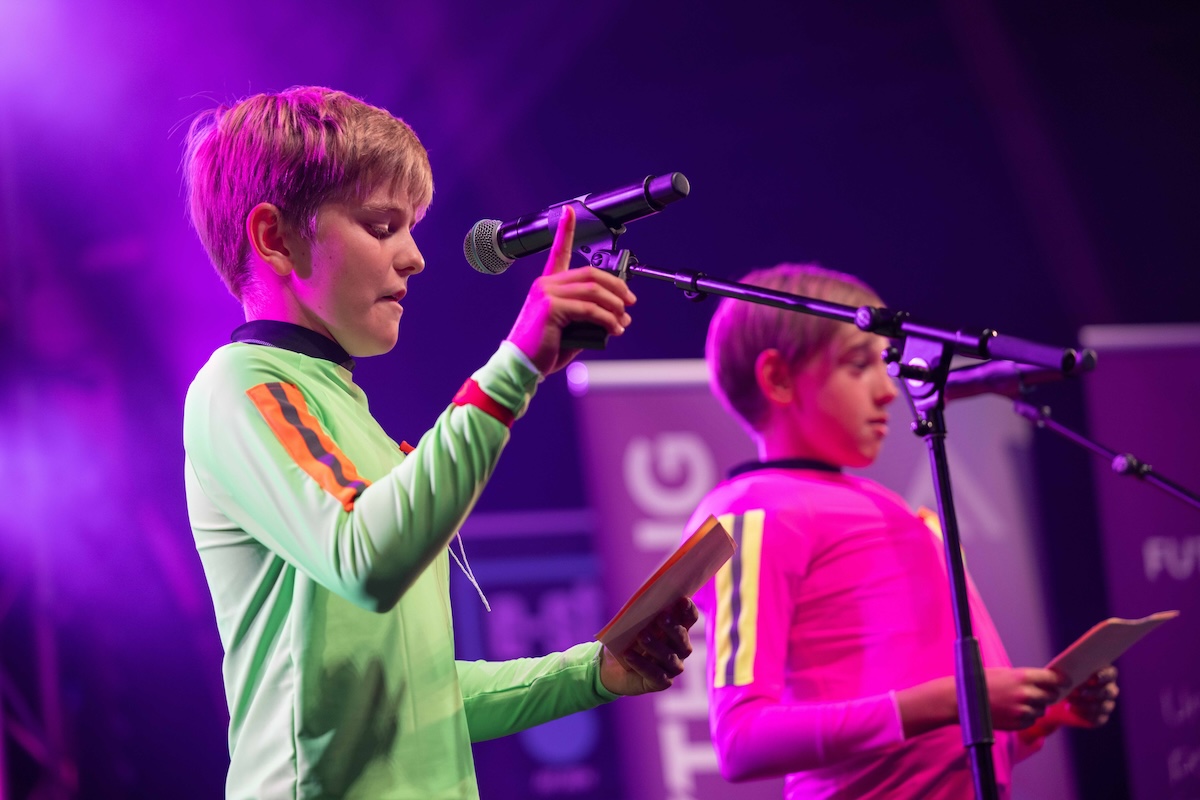
Everything on this page, from the niche problems to the real points of difference to the traction, is about to be put to the test. On 13–14 October, the top 48 teams pitch live and online at the Future Anything Challenge Semi Finals, and you can watch how they answer the questions this page has been asking.
Tickets are free, and virtual attendance is participatory: you'll vote for your favourite idea on the day. Bring your class, your team, or your family!
Check out The Future Anything Challenge.